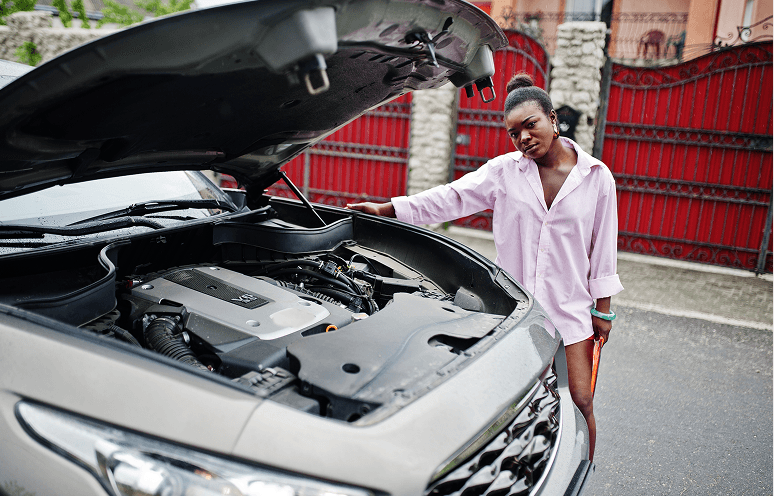
Africa buys the oldest cars in the world and has built almost nothing to catch them when they fail.
The numbers are plain. Between 2015 and 2018, the EU, Japan and the US exported about 14 million used vehicles, and roughly forty per cent came to Africa. When the Netherlands audited what was leaving its ports for West Africa, most vehicles had no valid roadworthiness certificate and most were sixteen to twenty years old. A quarter of those bound for Nigeria were close to twenty. These cars arrive already broken in ways their owners cannot see.
Then we run them on roads that find every weakness. No hard shoulders, so a breakdown means stopping in traffic instead of beside it. Unlit stretches. Flooded junctions that kill starter motors. Almost no distance markers, which creates a specific Lagos problem: even when you reach someone willing to help, you cannot tell him where you are. You describe your position by billboard. He arrives an hour later, if at all.
The Federal Road Safety Corps puts it starkly. Africa holds under three per cent of the world's registered vehicles and accounts for more than twenty per cent of its road deaths.
And a breakdown here is a security problem before it is a mechanical one. Stopping at night on the wrong road changes what you are actually dealing with. It is no longer about a flat tyre. It is about who is walking towards the car. So drivers refuse help from strangers, which is rational, and which also blocks the many strangers who would genuinely help.
Here is what most people get wrong: this is not a shortage of mechanics. Every major road in Lagos has vulcanizers within a few hundred metres. Obalende holds some of the best automotive expertise in West Africa. The skill is there. What is missing is everything that connects a stranded driver to it. No way to find the right person from where you are stuck. No way to confirm he is who he says he is. No price agreed before work starts. No recourse when it goes wrong.
So the price gets negotiated at the worst possible moment, beside a dead car, at night, with your family inside. Everyone knows how that ends. Drivers feel extracted from. And the vulcanizer loses too: his reputation cannot travel past his own corner, his income depends on who happens to break down near him today, and he has no protection when a customer refuses to pay. Both sides are worse off, and neither built the system that does it to them.
That is the gap. Not more asphalt, though we need that. A coordination layer: verified identity, visible prices, protected payment, precise location, real accountability.
That is what we are building at Drivly. Six services cover most of what strands people: flat tyre, jump start, towing, fuel delivery, lockout, mobile mechanic. Every job is priced upfront before you commit, so there is no roadside bargaining. Every provider passes a 105 point vetting check and carries a physical Drivly ID card, because a man approaching your car at night needs to prove who he is in the two seconds you have. Payment is held in escrow until the work is done, and if nobody accepts within five minutes, your money comes back automatically.
We take no commission from providers. Our margin sits in the customer price. The provider keeps everything he earns, because a platform funded by shaving the income of informal workers deserves to be abandoned by them.

We are starting on Lagos Island, across Lekki, Victoria Island, Ikoyi and Obalende. Coverage density beats a map covered in pins. Nobody cares that you operate in twelve cities. They care whether help reaches them in twenty minutes.
If you drive in Lagos, join the waitlist at usedrivly.com and get access first when we launch in your zone.
If you fix cars, change tyres or run a tow truck, join it too. You keep what you earn, we bring you the work, and the ID card in your pocket does what standing on a corner never could.
The cars are old and the roads are hard. Neither changes quickly. What can change is the hour after a car stops moving.